|
|
|
|
|
|
|
|
|
|
|
|
|
|
|
 |
|||
|
|
||
addicted?
I admit it getting
ready The Tour de France, the biggest, hardest cycle race, the biggest, hardest sporting spectacle in the whole world, with 15,000,000 people crowding the route last year to watch the race. Even the Olympics is not up to this. That only happens once every four years, and there the athletes are changed practically every day. It is soooo beautiful—red....yellow.....chrome.....space helmets bearing down like invaders from from Betelgeuse.....blue.....pink—even aerodynamic shoes. Orange glasses, clicking cycle gears ::::::::whooooshhhhh and he’s gone:::::: But wait, here comes another one:::::: It reminds me of the Streak:
How
can you not be here? How can you not watch the Greatest Show on
Earth as it rushes past a field of sunflowers or lavender, or
struggles up the Pyrenees? orientation: the tactics of the tourMuch of le Tour comprises long, flat stages. There are also two or three time
trials, even including one for teams. The Tour de France is a living and flexible event. Unlike a hundred-metre
dash, the stages and competition change every year. For example,
this year [2008] there will be no prologue stage, normally about
a seven-mile dash to open the proceedings. Further, there will
be no team time trial. This will be a disappointment to me, because
I just love watching the space invaders in perfect, coordinated,
colour harmony as they set out to capture another planet. My enthusiasm
is despite team time-trials having the slight inconvenience of
somewhat undermining the individual, gladiatorial nature of the
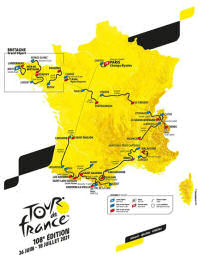
Tour. Thus, the aesthetic circus must compromise with raw competition. getting readySome months ahead of Le Tour de France, a crude little map (see above) of the intended race route appears in newspapers, magazines and on websites. I use the official Tour de France website. Next, a month or two before Le Tour starts, a detailed itinerary is posted at the Tour website. By two or three weeks before the start date, the details have also been published as an Official Tour de France Guide.[1] The itinerary and other race details are also produced, to various degrees, in many cycling magazines. It is only when the full itinerary appears, and
the excitement rises, that useful planning can start. Every year,
I swear off and convince myself – never
again! As the year goes by, and the carnival comes closer,
slowly I weaken until, comes the Great Day, there I am again sitting
on the roadside. Every person should see the Tour close up once,
but this is ridiculous. le tour itinerarySo, back to the day that the complete itinerary comes out. The Tour winds along little country lanes and down long, straight Roman roads, ripping through France’s towns and villages. But if you really want to see the Tour, and not just whoosh whoosh, then like the Streak they are gone, you need to plan. That means decent, high-scale
maps of the race stage (étape) you have chosen
from the itinerary, including a map that shows bends in the roads
and contours.[2] reconnaissanceNo use to just go to the race roadside on the Great Day; you will not know where to park, or where are the best viewing positions. By the time you reach the course on the Great Day, the road will be blocked off to normal traffic, so you will have to approach it from a side road. Therefore, if you are to see the Tour properly, there has to be a reconnaissance mission. You have to go out days before the Great Day and survey your chosen target zone. (Note well that if you intend to watch a big climb on the mountain roads, you will probably be involved in taking up your position the previous day and camping out overnight. For more details see Le Tour 4 - in the Pyrenées (advice also applicable for the Alps).) Of course, serious mugs have the full itinerary the very moment it is published, and start ringing round appropriately placed hotels on the route to reserve a room. Necessary because local hotels quickly book up for the night before the Tour comes through. Many of the best hotels, in the stage start towns, will have already been grabbed by the Team armies (les équipes) who, of course, have prior notice of the race route. If you manage to book into such a hotel, you will have not to mind the the broom cupboard allocated to you, the French drains or the local revellers. Many, many other spectators use camper vans, or carry tents in their cars. Do not think that an aficionado can be ecological about this game (you can be, if you just want to visit one stage on a bicycle). There is no way that anyone but a super-fit cyclist can keep up with these guys. Even the bike gladiators have a couple of rest days, then fly or train to the next stage start. In the midst of choosing the perfect spot, remember that, by July, France is mostly a land of blue skies and hot sun. Find a shaded spot for the hours of waiting, unless you decide to bring a parasol or erect some other sun shelter. So back to planning your wonderful day out. Now remember that I, abelard, just hate the crowds and the places that tend to attract them, especially the mountains, and other stage finishes. If you don’t mind the crowds, then you will have different tactics, maybe picking the winding, narrow road through a French village, or brawling for a place at the finish. But be warned, the Tour takes over even fairly small towns where the stages begin and end. You will be lucky to enter the town in a vehicle, let alone find somewhere to park, on the day. Ah yes, the mountain stages. Well, it’s like this. On the flat stages, it is normal for most of the peleton (that’s the pack to you) to keep together for wind protection, with maybe a breakaway group or two, and a final sprint to the extremely crowded finish line. But it is on the hills and mountains, in the Alps and the Pyrenées, that the weaker reeds start to spread out; yes, the hills actually do slow down the riders. Thus, you see more lycra for your delight if you chose a place where you can watch the Tour coming up a slope. So, back to your maps: you want to chose a place where you can see somewhat into the distance. Remember the Streak chorus – “Here he comes ... There he goes”. A long, slow, uphill slope makes the most of watching packs of cyclists regularly moving at 30 mph (48 kph). Right, you have that? Now the specifics, where are you going to park and where are you going to sit, is next in the campaign planning. Sure as eggs, if you chose badly, those pesky locals are going to park themselves and their encampment precisely in front of the position you have taken, even if you did arrive much earlier. They have never heard of queuing or manners, especially when they want. And don’t forget, the locals also have a good idea which are the good observation points. Having worked all this out, and laid your plans, it’s the end of another ‘exciting’ day until the Great moment arrives. Le Tour 3: the Great Day arrives
|
||
new! Cathedrale Saint-Gatien at Tours
the perpendicular or English style of cathedral the fire at the cathedral of Notre-Dame de Paris Stone tracery in church and
cathedral construction stained glass and cathedrals in Normandy fortified churches, mostly in Les Landes cathedral labyrinths and mazes in France Germans in France on first arriving in France - driving
Transbordeur bridges in France and the world 2: focus on Portugalete, Chicago,
Rochefort-Martrou France’s western isles: Ile de Ré Ile de France, Paris: in the context of Abelard and of French cathedrals Marianne - a French national symbol, with French definitive stamps la Belle Epoque
Pic du Midi - observing stars clearly, A64 Futuroscope the French umbrella & Aurillac 50 years old:
Citroën DS the forest as seen by Francois Mauriac, and today bastide towns what a hair cut! m & french pop/rock
|
| abstracts | briefings | information | headlines | loud music & hearing damage | children & television violence | what is memory, and intelligence? | about abelard | ||
© abelard, 2004, 24 june the address for this document is https://www.abelard.org/france/le-tour2.php |